Built and live.
Four systems. Different stacks, same method. Every number below comes from code, logs or direct measurement.
The company's data platform
Zero wrong in 170,000 checks
No photograph: internal company system- Scope
- inherited half-built data platform
- Scale
- about 1,500 things in production
- Result
- zero wrong in 170,000 checks
The company's central data platform (a "lakehouse"): the place every number comes from, and the reports built on top of it. Inherited half-built, turned into the real thing.
When the reports were moved, a tool compared every number in the old report against the new one, 170,000 of them. Nothing was wrong.
170,000 automated cell checks, zero real discrepancies
- Took over a platform a consultancy had started and built it into the one the company runs on: the framework, the jobs, the structure, the rules. About 1,500 moving parts the business relies on every day: tables, scheduled jobs, rules.
- Moved 11 reporting systems people open every day onto a faster foundation, in 14 working days, using about 40 small tools built for the job. 11 production report modules moved onto Fabric Direct Lake in 14 working days with ~40 purpose-built tools.
- The quiet bugs: 11 columns being added up when they should not have been, and 59 charts that lost their ordering. The tools caught them. Eyes would not have.
Azure Databricks · Unity Catalog · Fabric · Power BI · GitLab CI

konradvanstaden.com
63× lighter
- Scope
- author's site rebuilt with booking
- Scale
- 19 pages, one for each of 18 books
- Result
- 63× lighter, 923 KB to 14.6 KB
An author's website, rebuilt from the ground up with a booking system behind it.
The old page was a 923 KB download. The new one is 14.6 KB. It shows up instantly, even on a phone.
923 KB → 14.6 KB first paint, gzipped
- The old site was one bloated page. Now it is a light homepage plus a page for each of his 18 books, and none of it loads anything from anyone else's servers. Rebuilt from a 1.3 MB legacy Joomla page into 19 static pages. Zero external requests on load.
- The booking system went live quietly. Until its last piece was in place the site kept using the old email link, so nothing ever broke for a visitor. Booking backend with no flag day: ships dark, falls back to yesterday's mailto until its key lands.
- The switch to the new site was scripted, with a five-minute way back if anything went wrong. Checked on the real address before calling it done.
Astro · Cloudflare Pages · Resend · Playwright
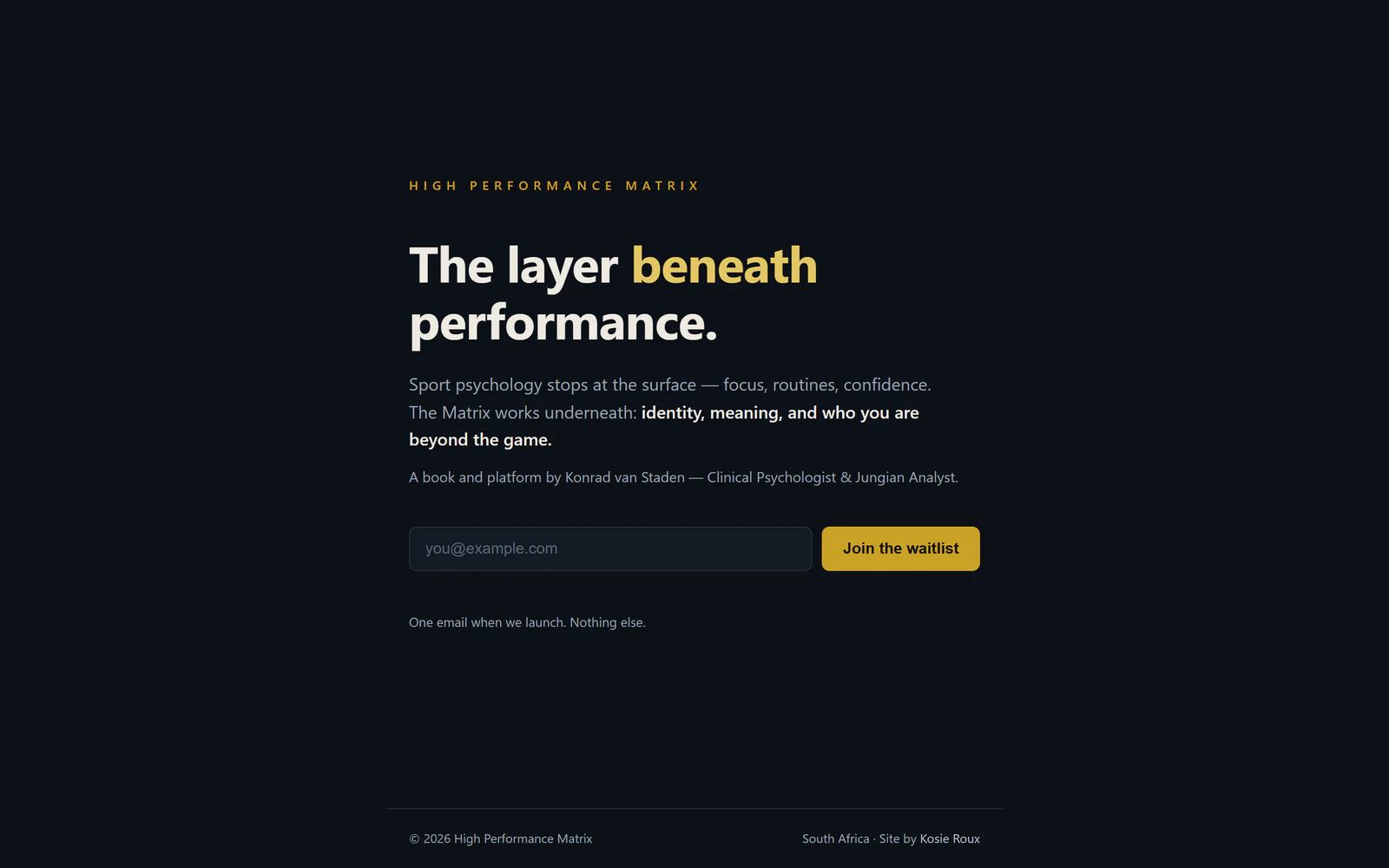
highperformancematrix.com
5 days
- Scope
- new venture, live coming-soon page
- Scale
- 3 web addresses, one live page
- Result
- docs to live waitlist in 5 days
A new venture that handles sensitive personal data. From a pile of documents to a live coming-soon page with a working waitlist, on three web addresses, in five days. The platform behind it is still being built.
From nothing but documents to a live page people could sign up on. The product itself is still in the works.
- Three web addresses, all landing on the same page. A founding sprint, not the everyday pace.
- Private data is treated as private from the first design: scrubbed before it moves anywhere, and every consent written to a record that cannot be edited afterwards. Special-category data posture from day one: redaction at every boundary, an append-only consent ledger.
- A test said the AI was fine. It wasn't: a setting was cutting its reasoning short. Finding that mattered more than the passing test. The eval that passed and changed nothing: the real finding was max_tokens starving reasoning. A safety parameter, not a cost knob.
Next.js · TypeScript · Drizzle · Postgres · Railway EU · Sentry · Cloudflare
The one I can't name
1,627 changes in 5 months
No photograph: the contract bars naming it- Scope
- paid AI product, built end to end
- Scale
- 1,627 saved changes in 5 months
- Result
- live, with paying customers
A paid AI product, built from the first line of code to live customers. The contract says I cannot name it.
Every saved change to the code is recorded. This is how much got built, and how fast, by one person working with AI.
1,627 commits in 5 months
- Everything, end to end: how it is put together, what it costs to run, the guardrails, getting it live, taking payment.
- Fourteen AI reviewers check the work, each with one clear job. Every brief also says what that reviewer must leave to the others, so nothing is checked twice or missed.
- The manual checks itself. Every instruction in it gets test-run against the live system, so the docs cannot quietly go stale.
Tools not listed, same reason as the name.